South Australia Nomination for the National Innovation Visa (NIV 858)
- June 12, 2026
- 3,38512:41 pm
The Fastest, Smartest Pathway to Australian Permanent Residency in 2026
TL;DR (For the scanners)
- The National Innovation Visa (Subclass 858) is Australia’s only permanent residency that grants PR from day one – no provisional stage, no points test, no age cap.
- Home Affairs invites applicants in 4 strict priority groups. Without a state nomination, Priority 3 and Priority 4 candidates wait 4–7 months minimum often longer.
- A state nomination lifts you into Priority 2 – the second-fastest queue after Nobel-tier laureates.
- Among all eight states and territories, South Australia has the cleanest, fastest, most strategically aligned nomination pipeline in 2026 – especially if you work in Defence, Space, AgTech, Critical Tech, Health, Renewables, FinTech, Education or Resources.
- The difference between a winning ROI and a rejected one is almost never the CV. It’s the strategy behind how the CV is positioned. That’s where we live.
The Uncomfortable Truth Most Migration Agents Won't Tell You
If you are a global researcher, founder, scientist, defence engineer, AgTech innovator, FinTech leader, professor, engineer, health expert or critical-technology expert eyeing Australian permanent residency, there is one truth nobody is telling you loudly enough:
The only real way to accelerate your National Innovation Visa (Subclass 858) is to secure a State Nomination and South Australia is currently the most strategic door in the country
I have watched hundreds of brilliant applicants, published professors, defence engineers from BEL and HAL, FinTech founders out of Bengaluru, AgTech scientists from ICAR – submit Expressions of Interest to Home Affairs and then wait. And wait. And wait. Some are still waiting nine months later, while their Australian peers with state-nominated Form 1000s in hand received invitations within weeks.
This article is the complete, no-fluff guide to the South Australia Nomination Process for the NIV 858, written from the trenches of our daily casework at VOYAGER COMPASS CONSULTANCY LLP , where state nomination strategy is what we do every single day.
Why the National Innovation Visa (NIV 858) Is the Most Coveted PR Pathway in Australia
The National Innovation Visa (Subclass 858) replaced the Global Talent Visa in late 2024 and is now Australia’s flagship permanent residency stream for individuals with an recognised record of exceptional and outstanding achievement in a profession, sport, the arts, or academia and research (Department of Home Affairs).
- Permanent residency from day one: no temporary stage, no waiting list, no points test
- Full work, study and Medicare rights: for the applicant, spouse, and dependent children
- A direct path to Australian citizenship: (typically after 4 years of residency)
- No age cap: (those under 18 or 55+ must demonstrate benefit to the Australian community)
- No occupation list: your field just has to be one of the priority sectors
- No English ceiling at IELTS 8: Functional (IELTS: 4.5) English is sufficient if your achievements speak
The 4 NIV Priority Groups - And Why Your Position Decides Everything
The Department of Home Affairs invites NIV applicants in four strict priority groups:
| NIV Priority | Who Qualifies | Realistic wait time for invitation |
|---|---|---|
| Priority 1 | Global laureates: Nobel, Olympic gold, Fields Medal, Pulitzer-tier recognition | Days to weeks |
| Priority 2 | Candidates nominated by an Australian Commonwealth, State or Territory Government via Form 1000 | Weeks |
| Priority 3 | Tier 1 sectors – Critical Technologies, Health Industries, Renewables & Low-Emission Technologies | 4-9 months (assessed monthly) |
| Priority 4 | Tier 2 sectors – Agri-food & AgTech, Defence & Space, Education, Financial Services & FinTech, Infrastructure & Transport, Resources | 6-12+ months (assessed monthly) |
Here is the unlock nobody wants to spell out:
That is the single most powerful lever in the entire NIV ecosystem. It is the difference between getting your invitation in 30 days versus 300. And it is exactly what we engineer for our clients every single week.
Why South Australia Is the Smartest State to Target in 2026
Four reasons South Australia stands apart in 2026:
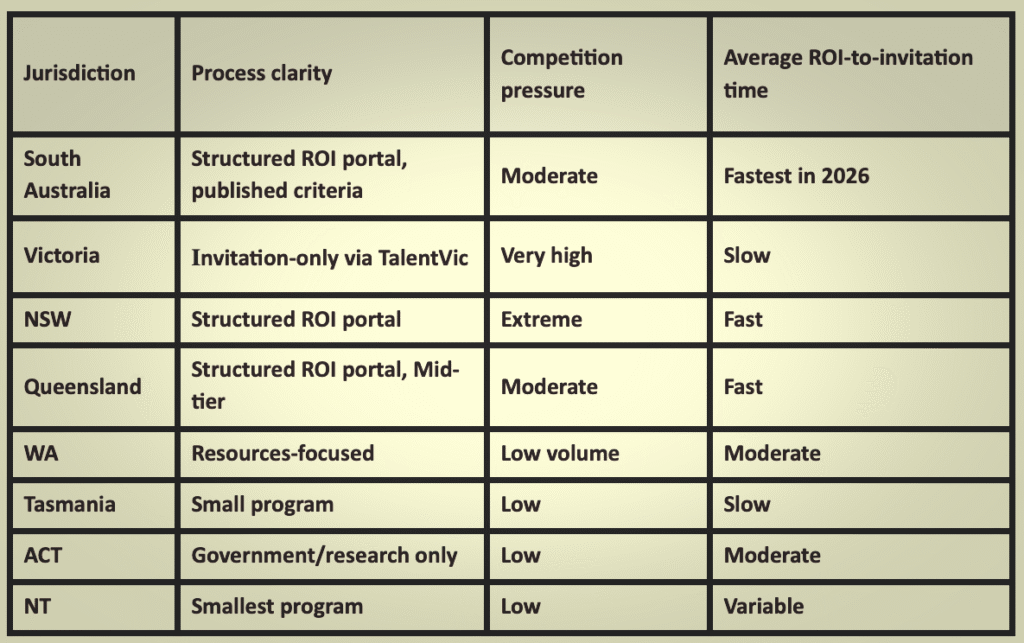
| Jurisdiction | Process clarity | Competition pressure | Average ROI-to-invitation time |
|---|---|---|---|
| South Australia | Structured ROI portal, published criteria | Moderate | Fastest in 2026 |
| Victoria | Invitation-only via TalentVic | Very high | Slow |
| NSW | Structured ROI portal | Extreme | Fast |
| Queensland | Structured ROI portal, Mid- tier | Moderate | Fast |
| WA | Resources-focused | Low volume | Moderate |
| Tasmania | Small program | Low | Slow |
| ACT | Government/research only | Low | Moderate |
| NT | Smallest program | Low | Variable |
- A live, structured Registration of Interest (ROI) portal – no guesswork, no closed lists, no “we’ll call you if interested”
- Deep alignment with NIV Tier 3 and Tier 4 priority sectors – South Australia is the national hub for defence, space, AgTech, critical minerals, hydrogen, Education, Infrastructure, Transport, software engineering and health research
- A faster-moving, less saturated nomination pipeline compared to NSW and Victoria, where competition has hit unsustainable levels
- A welcoming policy posture – South Australia actively encourages talent, including those who do not yet have an Australian sponsor or endorsing body in place
Backed by the University of Adelaide, Flinders University, UniSA, the Australian Wine Research Institute, the Australian Space Park, and the Osborne Naval Shipyard, South Australia is engineered for exactly the kind of talent the NIV was designed to attract.
The South Australia NIV Nomination Process - Step by Step
Drawing from the official guidance at migration.sa.gov.au, here is exactly how the process works for NIV 858 applicants:
Step 1 – Self-Assess Against NIV and South Australian Criteria
Before touching the portal, every applicant must clear two bars simultaneously:
- Federal (Home Affairs) bar: Recognised record of exceptional and outstanding achievement, prominence in your field, ability to attract a salary at or above the Fair Work High Income Threshold (or equivalent for researchers, athletes, artists)
- South Australia bar: evidence that your skills, networks, or capital will measurably contribute to the South Australian economy in a priority sector
Step 2 – Submit a Registration of Interest (ROI)
You lodge an NIV Registration of Interest through the Skilled & Business Migration online portal. The ROI captures:
- Your sector and sub‑specialisation
- Salary history and current remuneration
- Your concrete plan to contribute to South Australia
- Any existing South Australian connections
You should also be ready to provide:
- Your education details and key qualifications
- Your employment or business details, including your current role, company, or enterprise activities
- The biographical (photo) pages of your passport
- The biographical pages of your spouse’s/partner’s and dependent family members’ passports (if applicable)
In addition, the form and any follow‑up questions will ask you to explain:
- How you plan to contribute to South Australia’s economy?
- How you expect to contribute to South Australia’s cultural and community life?
ROIs are reviewed on a rolling basis. There is no public quota cap, but invitations are issued strategically against state priorities.
Step 3 – Invitation to Apply for Nomination
If your ROI is competitive, South Australia issues an invitation to apply for state nomination. You then submit the full nomination application with supporting evidence, achievement portfolio, reference letters, evidence of recognition, business case, and a tailored South Australia contribution plan.
Step 4 – State Nomination Approval & Form 1000
Once South Australia approves the nomination, the state agency completes Form 1000 – Nomination for a National Innovation Visa, which is the document that catapults you into Priority 2 for Home Affairs processing.
Step 5 – Lodge the NIV 858 Application with Home Affairs
Within 60 days of receiving your invitation, you lodge the substantive Subclass 858 application in ImmiAccount with your Form 1000, full evidence bundle, health and character documents, and family inclusions.
Step 6 – Priority Processing, Decision, Permanent Residency
With state nomination in hand, your file moves into the priority queue. Permanent residency is granted directly – no provisional stage, no further state obligations beyond the genuine intention to settle and contribute in South Australia.
The 5 Mistakes That Kill 80% of NIV Applications (And How We Fix Them)
After managing NIV and predecessor Global Talent files across every Australian state, here is what we see fail most often:
1. Generic ROIs that read like resumes. South Australia is not assessing a CV. It is assessing a contribution story. A resume says “I did X.” A contribution story says “I did X, which positions me to deliver Y for South Australia, and here is the evidence-backed plan.”
2. Misaligned sector framing. A FinTech founder pitching as a “tech entrepreneur” loses the Priority 4 sector hook entirely. A data scientist with a health-AI product is sitting in Priority 3 (Health Industries) – if the file is framed correctly. Sector framing is everything.
3. Weak evidence. Citations, awards, media, board roles, leadership, business model, entrepreneurship, keynote invitations, patents, named contributions, and peer testimony must be curated and narrated. The evidence must tell a story of prominence, not just a list of links.
4. No South Australian thesis. “I will move to Adelaide” is not a thesis. “I will partner with SAHMRI on AMR genomics, hire two postdocs in Year 1, and establish a spin-out at Lot Fourteen by Year 2 – here are my three confirmed contacts at Flinders” is a thesis.
This is why state nomination is a strategic exercise, not a clerical one. At Voyager Compass Consultancy, state nomination is our master craft. We have built South Australian, Victorian, NSW, Queensland, Tasmanian, and Northern Territory nomination pathways for engineers, researchers, founders, defence specialists, AgTech leaders, FinTech architects, and global academics. We know precisely how each state reads an ROI, what evidence triggers an invitation, and how to position a candidate so the Form 1000 becomes a question of when, not if.
Frequently Asked Questions (FAQs)
Is South Australia better than Victoria for NIV nomination in 2026?
How long does the full NIV process take with South Australia nomination?
Do I need a job offer in South Australia before lodging the ROI?
Can I apply for NIV from outside Australia?
Yes. NIV 858 can be lodged onshore or offshore. South Australia’s nomination program accepts both.
What is Form 1000 and why does it matter so much?
Is there an English language requirement?
Not strictly required.
What does a state-nominated NIV grant give my family?
The Bottom Line for NIV 858 Hopefuls
If you are serious about the National Innovation Visa and you do not already have a Nobel Prize or an Olympic gold medal in the drawer, your fastest, most controllable, most evidence-based route to a 2026 grant is a South Australian State Nomination – particularly if your sector sits in NIV Priority 3 (Critical Technologies, Health Industries, Renewables) or Priority 4 (Agri-food and AgTech, Defence and Space, Education, Financial Services and FinTech, Infrastructure and Transport, Resources).
State nomination is the only legitimate way to leapfrog the monthly Priority 3 and 4 queue. South Australia is the most strategically aligned state for the majority of NIV-eligible profiles in the world right now. And the difference between an ROI that wins an invitation and one that disappears into the inbox is the strategy behind it.
That strategy is exactly what we build for every client we take on.