Two National Innovation Visa (Subclass 858) Wins, Two Different Paths: How Our Clients Earned Their Australia PR Invitations
- 31 August 2026
- 9856:52 am
One email. A direct doorway to Australian permanent residency.
Verified Wins, Not Just Claims
Case One: The Clean Energy Expert | ITA in Renewables and Low Emission Technologies (July 2026)
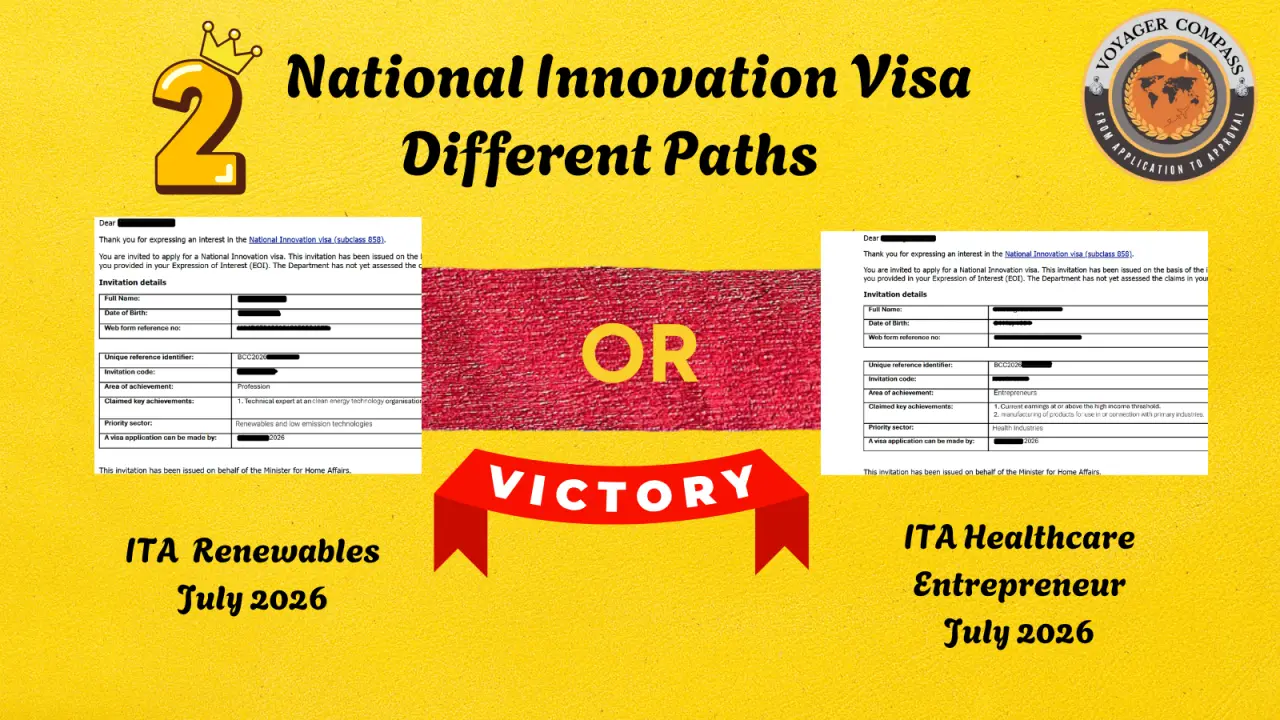
Our first client is a technical expert at a clean energy technology organisation and his invitation, received in July 2026, tells you exactly how the Department saw him:
- Area of achievement: Profession
- Claimed key achievement: Technical expert at a clean energy technology organisation
- Priority sector: Renewables and Low Emission Technologies, a Tier One priority sector
Here is what makes this win remarkable. His invitation did not rest on academic output — the Department’s own letter records his professional standing as the claimed key achievement. He was invited as a working professional because clean energy technology is one of the specialisations Australia has formally named inside its Renewables and Low Emission Technologies priority sector, the technology mission driving the nation to net zero¹.
And the competition is brutal. In the most recent published quarter (April–June 2026), the Department received 2,166 Expressions of Interest and issued just 248 invitations and only 33 of them nationwide went to Renewables and Low Emission Technologies. Roughly one invitation for every nine EOIs lodged. Our client is one of those 33.
What did we do? We did not manufacture merit, we revealed it. We mapped his professional record, his technical leadership, and his role in the clean energy transition directly against the Department’s indicators of exceptional and outstanding achievement, and positioned his specialisation squarely inside the Tier One sector definition, so an assessor could see, instantly and undeniably, that he operates at the top of his field. The talent was his. The strategy was ours.
Result: an ITA under Renewables and Low Emission Technologies, received July 2026.
Case Two: The Healthcare Entrepreneur | Health Industries, the Entrepreneur Route
Now, the case that surprises people.
Our second client held no patents, no research, and no intellectual property. By the traditional definition, he was not a “researcher” at all. He was something else — a successful healthcare entrepreneur from India with a proven business, strong earnings, and a genuine vision for Australia. His invitation letter records it in the Department’s own categories:
- Area of achievement: Entrepreneurs
- Claimed key achievements: Current earnings at or above the high income threshold; manufacturing of products for use in or connection with primary industries
- Priority sector: Health Industries, a Tier One priority sector
So we chose a completely different door: we built his case as an entrepreneur, anchored by a New South Wales (NSW) state nomination strategy through the entrepreneur pathway. We helped him articulate exactly:
- How his proven, successful healthcare business in India could be innovated and rebuilt in Australia
- How it would benefit the economy: jobs, investment, and enterprise
- How it would enrich the community: bringing a new model of care and community value
- How his deeper inspiration: the drive to do something noble through business aligned with the future Australia wants to build
Put these two cases side by side and the truth becomes obvious.
One client won as a professional a technical expert in renewable energy and clean technology. The other won as an entrepreneur on business success and economic contribution in health industries. Same visa. Same permanent residency in Australia. Two entirely different routes.
The three Tier One priority sectors (Critical Technologies, Health Industries, and Renewables and Low Emission Technologies); the Tier Two sectors from AgTech to FinTech; state nominations across NSW, South Australia, Northern Territory, Tasmania, and Victoria; and government-agency Form 1000 nominations that can accelerate a case into a higher priority tier.
The applicant brings the achievement. The strategy decides which door opens.
Do You Qualify for the National Innovation Visa? What Every Australia PR Aspirant Should Know
If you are a researcher, scientist, technologist, founder, entrepreneur, or senior professional wondering whether the NIV 858 is your Australia PR pathway, take both these clients as proof:
- A professional record of technical excellence in a Tier One sector can win an invitation.
- A a proven business, earnings at or above the high income threshold, and a genuine innovation story can win through the entrepreneur route.
- There is no points test and no skills assessment: the NIV is invitation only: you submit a Expression of Interest (EOI), it stays valid for two years, and the Department invites the strongest cases.
- What you do need is the right pathway, the right positioning, and the right story evidenced the way Australia expects to see it.
That is our entire craft at VOYAGER COMPASS CONSULTANCY LLP. We don’t fill forms. We build cases. We take real achievement yours and we establish the right way forward, professionally shaped and strategically placed, so it lands where it belongs.
Work With Voyager Compass Consultancy LLP
We are licensed consultants specialising in Australia’s National Innovation Visa (Subclass 858) Licence No. 823/I.C, Registration No. ACR-6398 and our expertise has been featured across major platforms including Zee News, India.com, MSN, DNA, Yahoo Finance, and TechBullion. From Application to Approval.
If your work has built something exceptional in clean energy, technology, research, healthcare, business, or beyond there may be a door to Australian permanent residency designed precisely for you. Let’s find it together, starting with one honest assessment.