
Explore Our Blog

Important Updates

National Innovation Visa 858 Australia 2026

The Definitive Guide to Talent-Driven Permanent Residency
The Revolution Nobody Saw Coming

Imagine stepping off a plane in Sydney not as a temporary visa holder grinding through
bureaucratic points systems, but as a Permanent Resident, no mediocre English scores required, no bank statements flaunted, no occupation checklists to squeeze into. Just your talent. Your track record. Your innovation.

The National Innovation Visa Subclass 858 (NIV 858) made this impossible reality possible on December 7, 2024, replacing a decade of rigid Global Talent pathways with a meritocracy that actually means merit.

At Voyager Compass Consultancy LLP , we’ve guided exceptional professionals through this
shift, from tech architect to sports innovator. What we’ve learned: Australia finally got it right.
Talent wins. Full stop.
 

National Innovation Visa 858 Australia 2026

Why 2026 Is Your Window:

The Legacy Problem: Immigration’s Gatekeeping
Australia’s traditional skilled migration created a psychological prison:
Subclass 189 (Skilled Independent):
You needed 65+ points. Rigidly calculated. Age? 30 years = 30 points; 45 years = 10 points. Occupation? Only approved codes (accountants, nurses, IT). Entrepreneurship? Irrelevant. Peer-reviewed publications? Meaningless. Patents? Nobody cares. You either fit the box or you didn’t. Millions qualified; thousands waited years. The system wasn’t broken—it was designed to be exclusive, not exceptional.
Investor Visas (188/888):
AUD 5M+. Full stop. If you didn’t have it liquid, you were out. A biotech founder who’d raised AUD 50M in VC but kept it invested? Rejected. An AI researcher worth billions in IP but liquid-poor? Rejected. Money was the gatekeeper, not innovation.
Global Talent Visa (Pre-Dec 2024):
The predecessor tried to fix this—direct PR for exceptional talent. But it was slow (3-4% invite rates), limited in sectors, and buried under bureaucracy. Good intent, poor execution.
NIV 858’s Radical Shift: Talent Over Everything
No VETASSESS or Skills Assessment
Forget occupation codes. NIV 858 doesn’t care if your role isn’t “approved.” The department asks one question: Are you internationally exceptional? Submit a patent? Unprecedented research? Venture-scale success? Recognized award? Welcome. A biotech researcher working on gene therapy doesn’t need VETASSESS approval, patents in Nature Biotechnology are the approval. A climate tech founder with pilot-scale hydrogen production doesn’t need occupational validation,working prototypes are validation.
Minimal English Requirement
Functional English, not the “superior” benchmarks of legacy schemes. And exemptions exist: UK/US/Canada/NZ passports bypass English altogether. Compare this to Subclass 189 roles requiring IELTS 7.0+. NIV 858 assumes you can communicate; it doesn’t demand linguistic perfection. A brilliant quantum physicist from Germany needs no IELTS-passport exemption kicks in.
Zero Financial Proof Barrier
This is the seismic shift. Investor visas demanded AUD 5M+. Legacy schemes expected 3-year financial statements. NIV 858? Visa fees only: AUD 4,840 main applicant + AUD 2,420 partner + AUD 1,210 per child. That’s it. A startup founder running lean can prove venture traction (revenue, user growth, fundraising) instead of personal net worth. An entrepreneur with zero savings but disruptive IP qualifies. Innovation is the currency, not cash
No Age, Job, or Income Caps
Under 18? Eligible with “exceptional benefit” proof (e.g., prodigy researcher, young entrepreneur). Over 55? Same rule. No job? Self-employment, freelancing, founding ventures all count. No minimum salary? Traction metrics (users, revenue, funding) replace income thresholds.
Family PR Included
Partner and dependent children (under 23, not married) get equivalent PR no separate qualification gauntlet. Medicare access, education pathways, unrestricted work full rights.
The Real Impact: The Numbers Don’t Lie
  • 6.6% EOI-to-invite rate (Q3 2025) vs 3-4% pre-launch
  • 8,000 EOIs yielded 304 grants in 2025 year-to-date (Q1-Q3)
  • Tier 1 sectors surged 40% (AI, biotech, renewables)
  • Priority 3/4 claimed 85% of invites meritocracy, not elitism
  • Processing accelerated: 50% of cases approved in 4 months (Dec 2025 data)

Translation: Entry barrier collapsed. Meritocracy ascended. If you’re genuinely exceptional in a priority sector, your odds just tripled.
Part 2: The Priority System Masterclass – Where 85% of Invites Actually Go
Monthly invitation rounds follow Ministerial Direction 112. The department ranks every EOI against explicit criteria. Highest ranks get first consideration. Official tracker updates [immi.homeaffairs.gov.au/visas/working-in-australia/visas-for-innovation/national-innovation-vi sa/current-invitation-round]
Tier 1: Global Icons (Priority 1) – The Instant Fast-Track
Who: Nobel laureates, Fields Medal winners, Olympic Gold medalists (any sport), Turing Award recipients, National Academy members.

Speed: Instant upon identification. No waiting.

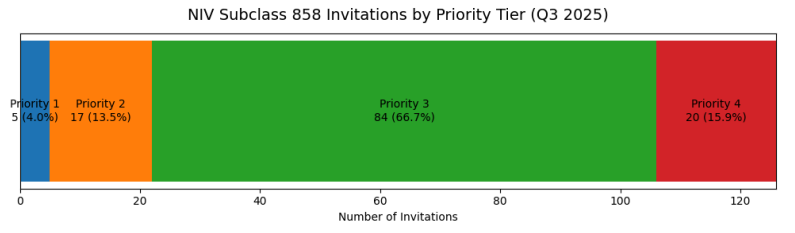
Q3 2025 Share: <5 invites (<4% of 122)
Reality Check: Unless you’ve won a major international award, this tier isn’t your path. But it exists for Australia’s “we’re serious about talent” messaging.
Tier 2: (Priority 2) – The Agency AcceleratorDocuments Required for IQA:
Who Qualifies: Nominated via Form 1000 by any of these eligible sources:
  • Australian citizen or permanent resident with national reputation in your field
  • Federal/state/territory government agencies
  • Research organizations (CSIRO, ARC, DST Group)
  • Universities with national research profile
  • Major tech/innovation organizations with established Australian presence
Key Point: Australian Citizens & PRs Can Be Your Nominator
What This Means: An individual Australian citizen or permanent resident who is nationally recognized in your sector can serve as your nominator. They don’t need to be government-affiliated, just credible, reputable, and able to vouch for your exceptional international achievements. What This Means: An Australian government body (CSIRO, NSW Innovation Board, Startup NSW) vouches for you. They’re saying, “This person will benefit Australia’s innovation ecosystem.”
Speed: Immediate post-EOI review. Cabinet-fast.
Dual Nomination Pathways:
  1. Citizen/PR Individual Route: Personal relationship + national reputation = Priority 2 boost
  2. Organizational Route: Government agency/university endorsement = automatic elevation
What This Nomination Means: Your nominator declares, “This individual has an internationally recognized record of exceptional and outstanding achievement, and their migration will be of exceptional benefit to the Australian innovation ecosystem.” Q3
2025 Share: 17 invites (14% of 122)

How to Unlock: Network with government research orgs, state innovation agencies.

Example: A researcher collaborating with CSIRO on battery tech gets CSIRO Form 1000 endorsement →
Priority 2 elevation → instant invite.

Indian Example: A biotech researcher with ongoing collaboration with Australian Institute for
Bioengineering could secure Form 1000 from the institute → Priority 2.

Tier 3: Exceptional Sector Talent (Priority 3) – The Dominant Tier (69% of Invites)
Who: Exceptional achievers in Tier 1 Critical Sectors:
  • Critical Technologies: AI/ML breakthroughs, quantum computing, cybersecurity, space tech
  • Health Industries: Genomics, precision medicine, biotech, medtech devices
  • Low-Emission Technology: Batteries, hydrogen, carbon capture, renewable energy infrastructure
Evidence You Need:
  • Patents (issued or filed): Proof of innovation
  • Peer-reviewed publications: 50+ cites in Nature/Science-tier journals
  • Venture funding/revenue: Bootstrapped or venture-backed success
  • Awards/recognition: Industry accolades
  • Network/collaborations: Global partnerships
Income Signal: AUD 167,500+ annually typically indicates “exceptional” status in these sectors.
Speed: Top of monthly invitation slots Q3 2025 Share: 84 invites (69% of 122) Why This Tier Dominates: Australia’s innovation shortage is real. They need AI/biotech/climate tech talent desperately. This tier captures Australia’s strategic needs + achiever profiles. It’s accessible without being a Nobel laureate. Position as Priority 3 (Tier 1) → 69% invite likelihood → 4-month processing → PR granted.
Tier 4: Outstanding Tier 2 Talent (Priority 4) – The Secondary Strong
Who: Outstanding achievers in Tier 2 Sectors:
  • Agri-food/AgTech: Precision farming, pest detection, supply-chain platforms
  • Defence/Space: Satellite tech, autonomous vehicles, materials science
  • FinTech: Blockchain, payment systems, algorithmic trading (100k+ users)
  • Education: EdTech with measurable learning outcomes, adoption scale
  • Infrastructure/Transport: Smart infrastructure, autonomous mobility
Speed: Monthly invitation slots (remainder fill) Q3 2025 Share: 20 invites (16% of 122)
The December 2025 & Q4 Snapshot
Q4 mirrors Q3 patterns: Priority 3 dominance continues (~70%+ in October rounds per AVIE, Wise Kangaroo trackers). Tier 1 digital tech surged 25%, health stable (+8%), renewables +12%. State nominations amplified the effect: SA entrepreneurs up 20%, NSW tech +15%, Victoria research +10%.

Why This Matters: If you’re Tier 1, the window is now. If you’re Tier 2, it’s still open NIV 858 vs Every Other Visa – Why It’s the Game-Changer

Your 2026 NIV 858 Action Plan : Voyager Compass Consultancy LLP Makes It Reality
Australia’s innovation economy isn’t waiting. Neither should you. The National Innovation Visa Subclass 858 proves one undeniable truth: Talent is the ultimate currency. Q3 2025 data : 85% of invitations going to Priority 3/4—confirms the pathway is open. Voyager Compass Consultancy LLP turns potential into permanent residency. India’s exceptional talent deserves Australia’s permanent future. Claim yours. 2026 won’t wait.

The December 2025 & Q4 Snapshot

A: Permanent residency visa for exceptional talent. You submit an achievement portfolio → Australia invites you → You apply with docs/health → You get PR. No points test, no occupation list, no funds barrier. Just talent.
A: Same direct PR concept, but NIV 858 adds tier-based sector prioritization (Critical Tech, Health, Renewables), refined Ministerial Direction 112 criteria, and faster processing. More strategic, less bureaucratic.
A: Effective December 7, 2024. No new Global Talent applications accepted. All new applications route through NIV 858.
A: Australia-wide. But state nominations (SA, NSW, VIC) accelerate federal invites. Eligibility & Requirements
A: No. Self-employed, founders, freelancers, unemployed high-achievers are all eligible. Traction metrics replace employment contracts.
A: No. Job optional. Entrepreneurship, research, consulting all count.
A: No formal minimum. But AUD 167,500+ suggests “exceptional” in Tier 1 sectors.
A: Yes. No age cap. Over-55 applicants must show “exceptional benefit” (e.g., IP leadership, research breakthrough, venture scale).
A: Yes. The same “exceptional benefit” requirement applies.
A: Yes. Functional English is sufficient. Exemptions for UK/US/Canada/NZ passports.
A: You can apply from anywhere globally. India, US, UK, anywhere. PR granted allows immediate entry Priority & Sectors
A: Critical Tech (AI, quantum, cyber), Health (biotech, medtech, genomics), Renewables (batteries, hydrogen, carbon capture). These get 69% of invites. Not exclusive—Tier 2 viable too.
A: Check immi.homeaffairs.gov.au or Voyager assessment. AI/biotech/climate = Tier 1. FinTech/AgTech/Defence = Tier 2
A: 1 = Nobel laureates (instant), 2 = government-backed (immediate), 3 = Tier 1 sector talent (monthly top, 69% invites), 4 = Tier 2 (monthly remainder, 16% invites).
A: Australia’s innovation shortage is worst in Tier 1 (AI, biotech, climate). Strategic priority. Most applicants aren’t Nobel laureates, so Tier 1 sector talent dominates.

Leave a Reply

Your email address will not be published. Required fields are marked *

Call Now Button